
RUMINATION
SMELLING FEAR

This has been another two weeks where the ground was not quite as solid as I had hoped it would be. A dear friend, who was a truly loving gentle man, passed away at the beginning of the week and then we all awoke to the horrors of yet another catastrophic war igniting; these were just two of the collection of events that appeared to shake the earth. It is hard to remain upbeat sometimes and I would go as far as to say that there are some occasions when it is wholly inappropriate to feel anything other than sad.
This week I have begun to write chapter six of my book, titled Compromised. I wish I could report that I was struggling to find enough material to fill it, but in reality the difficulty was entirely caused by struggling to decide what to leave out. Just as I was working through the various sub headings, I opened the latest Vet Record to find a book review of One Health: Veterinary, Ethical and Environmental Perspectives, written by Michael W. Fox and a completely independent letter voicing concerns over adverse effects from methane inhibitors in ruminants. Reading both of these articles confirmed my already major concern that we are witnessing a serious mission creep between two sectors that each have very different aims. For most of my career, animal nutrition for livestock production was aimed at meeting the productive and physiological requirements of the animals concerned. Now the current directives from on high are focused on reducing ‘greenhouse gas emissions’ and pressuring farmers to reduce their environmental footprint, which has created a very uncomfortable encroachment into animal nutrition and animal welfare territory. (I am not debating the carbon story in this article but suffice it to say nothing is quite as it seems).
Optimising the ruminant gastrointestinal system used to be the goal of every stockman but apparently that view is currently off the table and compromising ruminal function to reduce methane gas production is the new goal.
The rumen is the biochemical engine of every ruminant. It houses a dense microbial consortium of bacteria, protozoa, fungi, and methanogenic (methane producing) archaea, that ferment structural carbohydrates (cellulose, hemicellulose - plant fibres) into volatile fatty acids (VFAs): acetate, propionate, and butyrate. These VFAs supply approximately 60–70% of the cow’s metabolisable energy.
During fermentation, hydrogen (H₂) and carbon dioxide (CO₂) are generated. If left unchecked accumulated hydrogen would inhibit microbial metabolism, so methanogenic archaea convert hydrogen H₂ plus carbon dioxide CO₂ into methane (CH₄) which is exhausted out of the system into the air. This hydrogen scavenging step is critical for maintaining redox balance in the rumen ecosystem. Methane production is not incidental, it is biochemically integrated into rumen function.
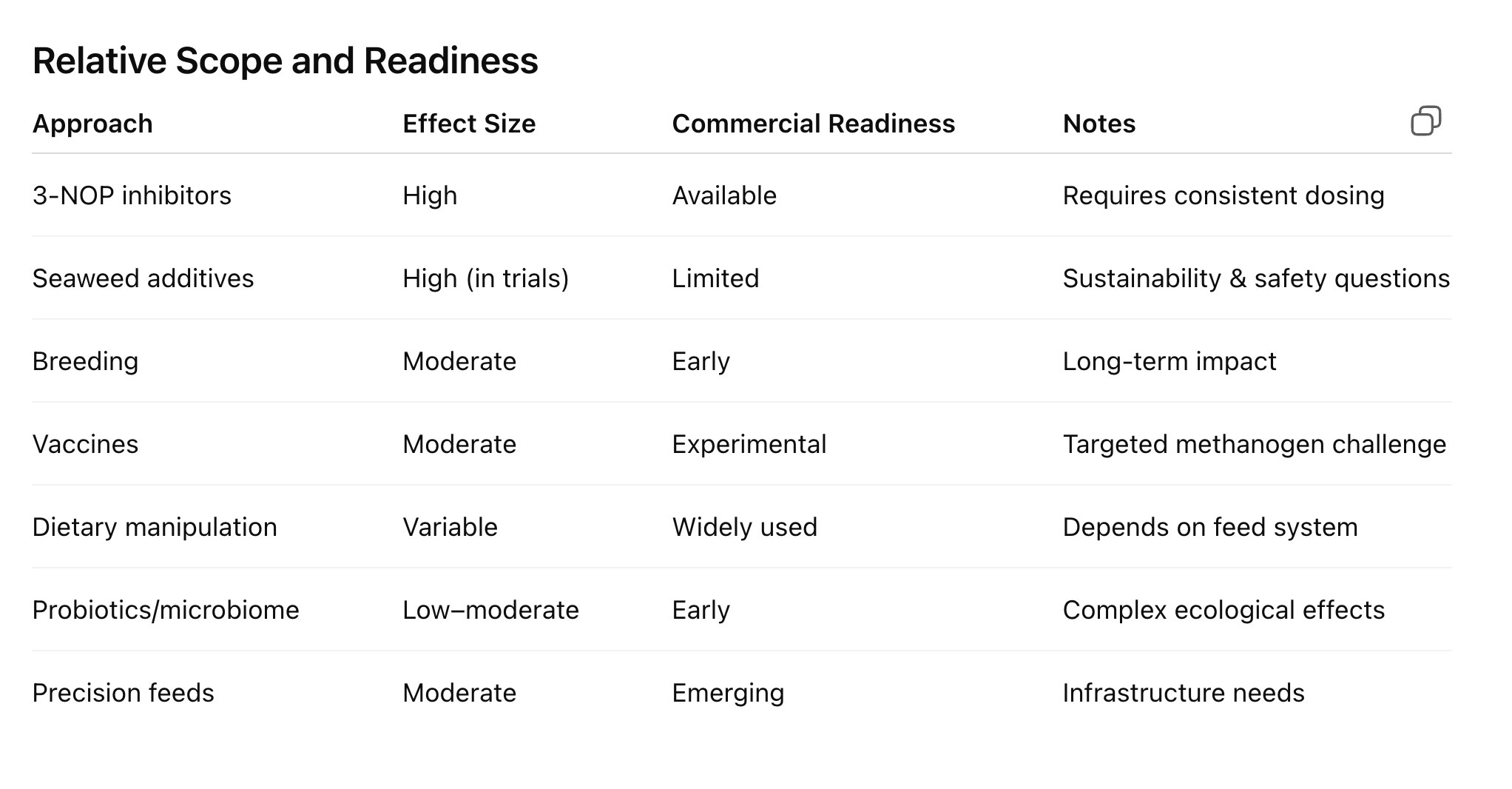
With the new main aim of feeding ruminants being greenhouse gas reduction and no longer animal welfare, the race has been on for a mixture of different mechanisms to reduce the methane production of ruminants. The table below gives a brief look at the many different options being explored and how near to market they are:
In October 2025, Denmark mandated methane-reducing measures for cattle, including the compulsory inclusion of Bovaer, a 3-NOP inhibitor, in dairy rations to meet national greenhouse gas reduction targets.
Since implementation, multiple Danish dairy farmers have reported adverse herd-level changes:
Reduced feed intake
Lower milk production
Lethargy
Digestive disturbances, including diarrhea
Some farmers claim herd-wide effects temporally associated with the introduction of Bovaer. These reports have circulated in agricultural media, including Farmers Weekly and Farmers Guide, amplifying sector-wide concern. Whilst industry trial data is not in line with these findings in the field, the Danish Food and Veterinary Administration is now monitoring herd health data and SEGES Innovation (industry) is collecting field data to assess potential correlations between Bovaer inclusion and reported symptoms. Unlike in the USA , where 3-NOP is regulated as a veterinary medicinal product that is then subject to pharmacovigilance under the FDA, the same is not true under EU legislation for feed additives.
For me the issue is nothing to do with whether or not the substance can reduce methane production, it clearly can, it should always have been whether large-scale deployment could be achieved without compromising rumen function, animal health, and production performance. The latter is highly unlikely to ever be true.
SMELLING FEAR
The equine sense of smell is often under-appreciated and many people believe that horses rely chiefly on sight, sound and touch, yet it is among the most ancient and functionally significant sensory systems in mammals. Horses possess a large nasal cavity richly endowed with olfactory (smell) receptors and both a main olfactory system and a specialised vomeronasal organ, located in the floor of the nasal cavity, that processes chemical cues, allowing them to detect an enormous range of scents in their environment. This capability evolved to support fundamental behaviours such as identifying forage, detecting predators, and interpreting social signals from other herd members, and it remains integral to how horses navigate their world.
